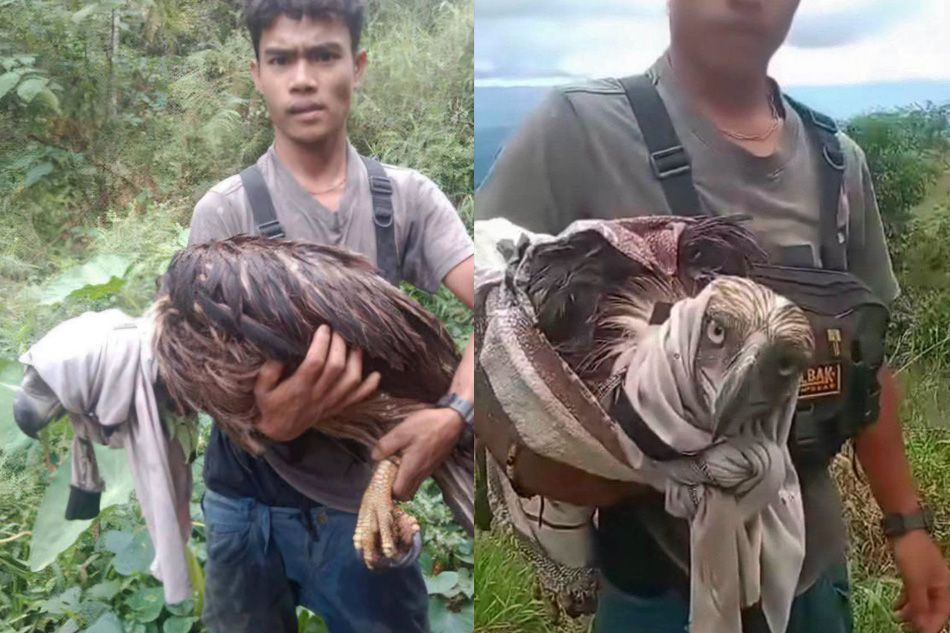
It started with an unusual sound coming from the bushes.
Marven Linoy, a 21-year-old Inhandig indigenous farmer from Malaybalay City, Bukidnon, was out in the mountains harvesting passion fruit when something made him stop. He followed the noise and found a Philippine Eagle — the national bird of the Philippines and one of the rarest raptors on earth — flat on the ground, surrounded by roughly 30 macaque monkeys in a frenzy.
Without hesitating, Marven did what any quick-thinking Bukidnon farmer might do: he imitated the bark of a dog. Loudly. The monkeys scattered.
What he did next showed just as much presence of mind. Rather than carry the eagle bare-handed, he covered its head with leaves from an anunutong plant to keep it calm, then wrapped its body in his jacket. He stayed with the bird and waited for help — and with the assistance of the Inhandig Tribal Multi-Purpose Cooperative (ITMPC), the eagle was safely turned over to the Department of Environment and Natural Resources (DENR) on July 3, 2026.
That eagle is now known as Sawaga-Dalwangan, named after the Sawaga River and Barangay Dalwangan where she was found. She is female, critically endangered, and — thanks to Marven — still alive.
1. A Bird That Should Not Have Survived
When the Philippine Eagle Foundation (PEF) received word of the rescue, they dispatched a team to Malaybalay immediately: a veterinarian, a senior animal keeper, a senior biologist, and a community development officer. What they found was a bird in desperate condition.
Sawaga-Dalwangan’s wing was heavily matted, severely infested with maggots, and her feathers were broken, filthy, and badly worn. She was so dehydrated she could barely hold herself upright. Rope burns on her legs suggested she may have been restrained at some point — and the extent of her injuries pointed to a bird that had been unable to move for several days before she was found.
She was transported to the Philippine Eagle Center in Barangay Malagos, Davao City for emergency care. PEF veterinarian Dr. Bayani Vandenbroeck was direct about what another day of waiting would have meant: another 24 to 48 hours without treatment, and she would not have made it.
2. What the X-Ray Revealed
Emergency treatment stabilized Sawaga-Dalwangan, but an X-ray examination delivered a harder truth — the eagle had two airgun pellets lodged inside her body. One was in her right wing; the other, deeper, in her left thigh muscle.
Veterinarians successfully removed the pellet from the wing. The one in the thigh, however, was too deeply embedded to extract safely and had to be left in place for now. The entry wounds were no longer visible on the surface, suggesting the eagle had been carrying those pellets for some time before the monkey attack even happened.
PEF Director of Operations Dr. Jayson Ibañez said the evidence raised serious questions. The combination of rope burns, advanced maggot infestation, severe dehydration, and airgun pellets pointed to injuries that were neither accidental nor recent. The PEF has since called on the DENR, the Philippine National Police (PNP), the National Bureau of Investigation (NBI), indigenous community leaders, and the local government of Malaybalay to launch a thorough investigation — to establish the facts, identify any violations of wildlife protection laws, and pursue the appropriate legal action.
3. Eight Days Later
Eight days into intensive care, Sawaga-Dalwangan is in stable condition. She has regained her appetite. She is alert. The bird that arrived at the wildlife clinic barely conscious is responding to treatment — and the team at the Philippine Eagle Center is continuing to monitor her recovery closely.
It is a result that almost didn’t happen, and it is a reminder of how quickly the outcome can change when the right people respond at the right time. Marven Linoy’s quick action in the mountains of Bukidnon bought this eagle the time she needed. The PEF team’s immediate response when they got the call kept her alive through the most critical hours. And the coordination between the local community, the ITMPC, the DENR, and the PEF proved that the system can work — when everyone does their part.
4. Why Bukidnon Carries a Special Responsibility
The area where Sawaga-Dalwangan was found is not just any stretch of forest. Barangay Dalwangan sits within the Mount Kitanglad Range Natural Park, and the surrounding territory has been a documented Philippine Eagle nesting ground since 1986 — making it the second-oldest known breeding territory for the species in recorded history. Eagles have been raising their young in these mountains for nearly four decades.
Today, Bukidnon is home to an estimated 23 known pairs of Philippine Eagles. That is a significant concentration for a bird so few in number — fewer than 400 breeding pairs are believed to remain in the wild across the entire country. When one of these birds goes down, it is not a small loss. It is a measurable blow to a population already on the edge.
Dr. Ibañez has renewed the PEF’s appeal to the provincial government of Bukidnon to tighten enforcement around jolen guns and air-powered pellet guns — the kind that left pellets inside Sawaga-Dalwangan’s body. The foundation’s Kontra Boga Program, run in partnership with the PNP, aims to get unregistered and unlicensed firearms out of the communities surrounding eagle territories. It is a practical program, and Bukidnon needs it.
5. A Farmer Who Deserves to Be Remembered
Marven Linoy has been praised across the country since his story came to light. Former Department of Agriculture Secretary Manny Piñol took to social media to call on Environment Secretary Juan Miguel Cuna to hire Marven as a DENR forest ranger — pointing out that the kind of knowledge, instinct, and love for the land that Marven demonstrated is exactly what conservation work needs on the ground.
It is hard to argue with that. Marven was not trained in wildlife rescue. He did not have any tools. He had leaves, a jacket, and the presence of mind to act. The Inhandig people of Bukidnon have lived alongside these mountains and forests for generations — and in that moment, their relationship with the land showed up in the most direct way possible.
Sawaga-Dalwangan is alive today in large part because a young farmer from Malaybalay decided to bark like a dog at thirty monkeys. That is a sentence worth sitting with for a moment.
6. It Took a Village — and Then Some
Behind every wildlife rescue is a chain of people, and the chain that saved Sawaga-Dalwangan was a long one. After Marven secured the eagle, Barangay Captain Royville Gabucan Pasco and the personnel of Barangay Dalwangan coordinated the handover to authorities. The Kitanglad Guard Volunteers-Kibenton (KGV-Kibenton) and the Inhandig Tribal Multi-Purpose Cooperative (ITMPC) helped move the bird to safety. Ms. Marjorie Tabernero of the City Environment and Natural Resources Office (City ENRO), Malaybalay City assisted on the ground alongside CENR Officer Dennis A. Juab.
The PEF team that responded to the call included Dr. Danielle Pasion (veterinarian), Dominic Tadena (senior animal keeper), Rowell Taraya (senior biologist), Carmen Simene-Tangara, and Jo Victoria Cristy Cruz. In Davao City, Dr. Bayani Vandenbroeck of Doc Bayani’s Animal Wellness Hospital carried out the radiograph, blood tests, and parasite screenings that guided the eagle’s ongoing treatment.
That is what it looks like when a community, a government, and a conservation organization move together. No single person could have done what all of them did together.
Bukidnon’s forests are home to something the rest of the world cannot find anywhere else. The Philippine Eagle is found only in the Philippines, and within the Philippines, this province holds one of the most important remaining populations. Every pair matters. Every nest matters. Every bird that makes it back to the sky matters.
If Marven’s story tells us anything, it is that conservation does not always look like a program or a government agency. Sometimes it looks like a 21-year-old passion fruit farmer who heard something wrong in the bushes and chose to go see what it was.
Sawaga-Dalwangan is recovering. The mountains are still watching over her. And Bukidnon — as always — remains in the conversation when it matters most.
If you ever come across an injured or grounded Philippine Eagle, contact the DENR or the Philippine Eagle Foundation immediately. Do not attempt to handle the bird on your own. Your call could be the difference.